Posts

Short Posts

Ramayana through carvings

Image
  Hazara Rama temple, Hampi This magnificent carving in the Hazara Rama temple delineate's the wedding of Lord Rama to Goddess Sita and of his brothers, Bharata, Lakshmana, Shatrughan to Goddess Sita's sisters, Mandvi, Urmila and Shrutakirthi respectively. Such intricacy and attention to detail can only be seen in Hampi, which was the capital of the Vijayanagara kingdom.  The most magnificent and perplexing moment occurred when I closely examined the Yajñōpaviīa thread found on the carvings of the four brothers. The three younger brothers' threads are all oriented to the left, but Lord Rama's thread is directed to the right. Could this be explained by the fact that Lord Rama was Lord Vishnu's incarnation? Was it because he was the oldest child? Or was it just etched to distinguish between the brothers' identities? Only the carver could have answered this question, because  after all, it is his interpretation that causes the confusion. But sadly, this carver exis...
Reflection

“…and then Lord Rama gained victory over evil by defeating Ravana and happily ruled in Ayodhya,” said everybody. This is truly the perfect and most straightforward conclusion of the epic Ramayana, and it is something I’m sure we all have heard. But was a righteous kingdom only established after killing Ravana? Was he the only evil that threatened society during that period? Certainly not ! The firm belief that Ravana was the primary antagonist and embodiment of evil is an idea I have scrutinised several times due to my intense fascination and interest in the epic. I started reading about every character intensely and examining them from different perspectives, leading to me a new paradigm. This new paradigm demonstrated how acts of greed and regression invite destruction. Continuously embodying Ravana as the story's villain makes people overlook other unjust acts in the epic committed by characters we think aren't immoral, such as abandoning a daughter to ensure the birth of so...

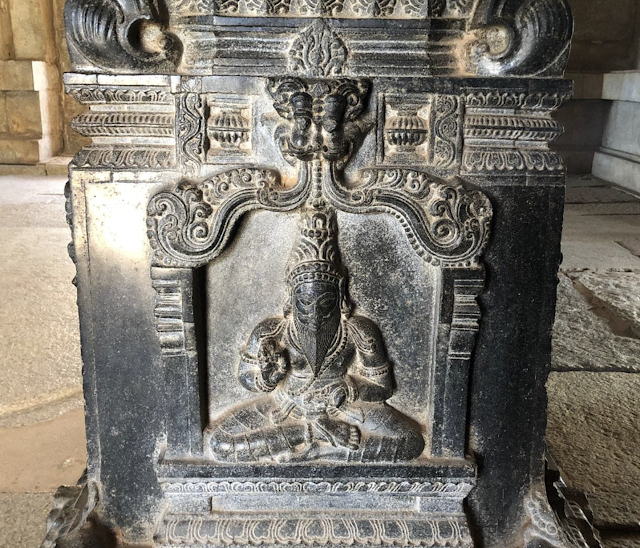
Rishi Agastya- stone carving, Hampi

Image
  Agastya was a respected Hindu sage. In Indian tradition, he is a notable recluse and an accomplished scholar in many languages of the Indian subcontinent, and he is credited with creating the Dravidian language, Tamil-the world's second oldest surviving language after Sanskrit. He also made significant developments to Ayurveda and Jyotish Vidya.

Chola architecture

Image
Gangaikonda Cholapuram, Thanjavur  

Ramayan through carvings (2)

Image
  Rama pierces seven tress through one arrow from Hoysaleswara temple, Halebidu The monkey king Vali could only be killed by the person who pierces 7 trees with one single arrow, so, when Lord Rama agreed to kill Vali, Sugriva challenged Rama to prove whether he truly was the one destined to end his brother's (Vali) life.

Exquisite carvings from Mahabalipuram- 2

Image
  Descent of the Ganges This carving on 2 monolith rock boulders depicts the story of how King Bhagiratha requested goddess Ganga to flow on earth and liberate his ancestors. Vishnu temple, Mammallapuram  The interiors of this temple contains phenomenal carvings of Lord Krishna lifting mount Govardhan

Exquisite carvings from Mahabalipuram, Tamil Nadu - 1

Image
  Ananta Shayana pose of Lord Vishnu, Mamallapuram

Apsara sculpture, Beluru- Chennakeshava Temple

Image
  Closely notice the smaller gandharva* near the apsara's left foot as well as the lizard to the left side of the apsara. Gandharva:  member of a class of celestial beings Source: photo taken by myself while visiting  Chikmagalur,  Halebidu and Beluru
Image
  Vamana Avatara - Channakeshava temple,Beluru